How to create project timelines: a 2026 guide
TL;DR:
- A project timeline is a structured schedule that organizes tasks, milestones, dependencies, durations, and owners into a manageable plan. It requires five core elements—clear milestones, assigned owners, dependencies, realistic durations, and a baseline—to be effective and reliable throughout the project. Proper decomposition, dependency mapping, three-point duration estimates, and regular updates are essential to keep the schedule accurate and enable successful project delivery.
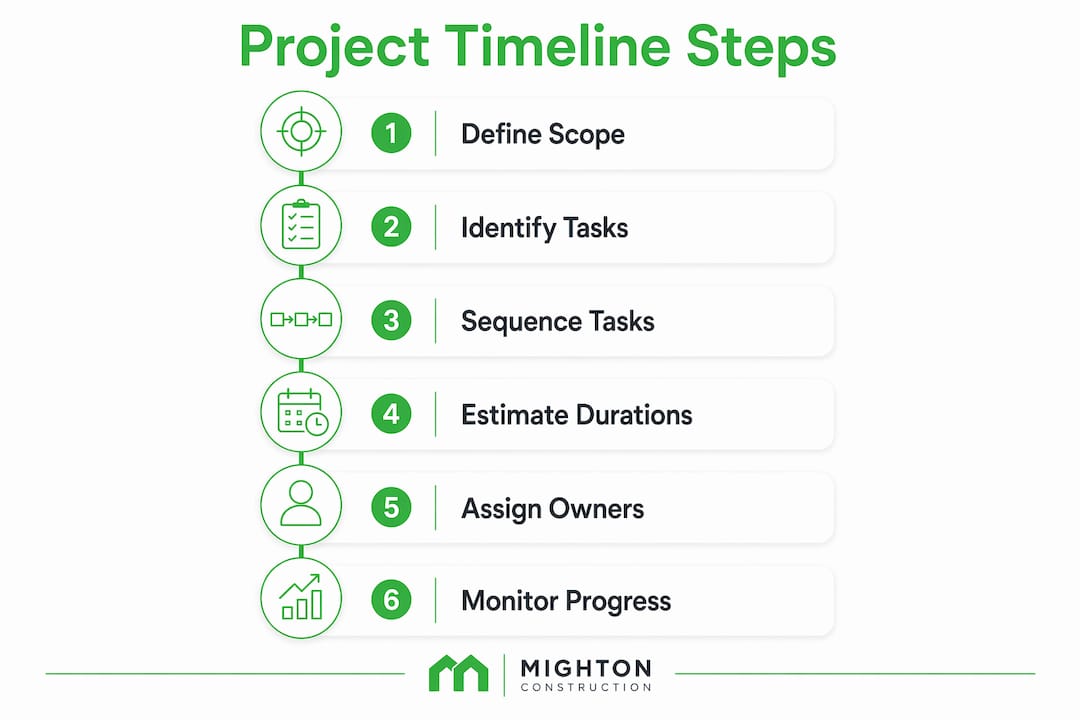
A project timeline is a structured schedule that organises tasks, milestones, durations, dependencies, and owners into a single, executable plan. Knowing how to create project timelines is the difference between a project that delivers on time and one that quietly unravels under shifting priorities and missed handoffs. In construction, software development, and renovation work alike, the schedule is not a formality. It is the primary tool for coordinating resources, communicating progress, and making decisions when conditions change. This guide walks you through every step, from defining scope to keeping your timeline alive throughout the project lifecycle.
How to create project timelines: the core elements you need first
A project timeline only works when it contains five specific components. Effective timelines require clear milestones, assigned owners, defined dependencies, realistic durations, and a designated baseline. Miss any one of these, and the schedule becomes a wish list rather than a plan.
Here is what each element does:
- Milestones mark the completion of a key phase or deliverable. They give the team a shared target and signal to stakeholders that progress is real.
- Assigned owners attach accountability to every task. A task without an owner is a task that waits.
- Dependencies show which tasks must finish before others can begin. They prevent teams from starting work on a foundation that does not yet exist.
- Realistic durations reflect actual working capacity, not optimism. Resource calendars and holidays must be factored in, or the schedule will conflict with reality from day one.
- A schedule baseline is the approved version of the plan. Every future update is measured against it to track variance.
Critical path analysis identifies the longest chain of dependent tasks that controls the project end date. Delays on the critical path push the finish date directly. Non-critical tasks carry float, meaning they can slip slightly without affecting the outcome.
Pro Tip: Build contingency time into your baseline from the start. A 10–15% buffer on the critical path is not padding. It is insurance against the inevitable surprises that every project encounters.
How do you break down work and sequence tasks?
The most common reason project schedules fail is that the work was never properly decomposed before the timeline was built. Experienced project managers break deliverables into work packages of 2–10 days in duration. This sizing makes estimation reliable and scope changes manageable.
The tool for this is the Work Breakdown Structure, or WBS. A WBS divides the total project scope into progressively smaller pieces until each piece is a concrete, assignable task. For a custom home build in Collingwood, the WBS might start with “foundation,” then break into “excavation,” “formwork,” “pour,” and “cure,” each with its own owner and duration.
Once the WBS is complete, you sequence the tasks using dependencies. There are four dependency types:
- Finish-to-start: Task B cannot begin until Task A is complete. This is the most common type. Framing cannot start until the foundation is cured.
- Start-to-start: Task B can begin only after Task A has started. Electrical rough-in and plumbing rough-in often run concurrently this way.
- Finish-to-finish: Task B cannot finish until Task A finishes. Final inspections and punch-list items often share this relationship.
- Start-to-finish: Task B cannot finish until Task A starts. This is rare but appears in shift-handover scenarios.
Unmapped governance gates and cross-project dependencies cause cascading delays. This matters enormously in construction, where a permit approval or a supplier delivery can hold up three downstream trades simultaneously. Map every external dependency explicitly, assign it an owner, and flag it on the schedule.
Pro Tip: Build a dependency register as a separate document alongside your timeline. List every dependency, its owner, and its expected resolution date. Review it weekly. This one habit prevents more schedule failures than any software tool.
| Dependency type | Relationship | Construction example |
|---|---|---|
| Finish-to-start | B starts after A finishes | Framing starts after foundation cures |
| Start-to-start | B starts after A starts | Electrical and plumbing rough-in run together |
| Finish-to-finish | B finishes after A finishes | Inspections and punch-list close together |
| Start-to-finish | B finishes after A starts | Shift handovers in continuous operations |
What techniques help you estimate task durations accurately?
Single-point estimates are the leading cause of optimistic, unreliable schedules. A project manager who asks “how long will this take?” and accepts the first answer is building a schedule on hope. Three-point estimation, also known as PERT estimation, corrects this by combining three scenarios.
The formula is: Expected Duration = (Optimistic + 4 × Most Likely + Pessimistic) ÷ 6.
For example, if a bathroom tile installation takes 2 days in the best case, 4 days most of the time, and 8 days when the tile shipment is delayed, the expected duration is (2 + 16 + 8) ÷ 6 = 4.3 days. That extra 0.3 days per task, multiplied across dozens of tasks, is the difference between a realistic schedule and one that collapses in week three.
Backward planning is the second technique worth mastering. Backward planning starts from the fixed final deadline and works backward through major milestones to the present day. This approach is particularly effective when a client has a firm move-in date or a seasonal deadline, such as completing a waterfront cottage in Wasaga Beach before the summer season opens.
- Identify the fixed end date.
- Place major milestones working backward from that date.
- Assign durations to each phase using three-point estimates.
- Check whether the resulting start date is feasible given current resources.
Rolling-wave planning handles the parts of the project that are too far out to estimate precisely. You plan the near-term work in full detail and leave later phases at a higher level until more information is available. Schedule development is continuous throughout the project lifecycle, not a one-time event at kickoff.
Pro Tip: Always check your duration estimates against your resource calendar before locking the baseline. A four-day task assigned to a tradesperson who is booked on another site for two of those days is actually an eight-day task.
How do you monitor and communicate your timeline effectively?
A project schedule that sits in a folder and is never updated is worse than no schedule at all. It creates false confidence. Schedules must be treated as living, visible documents that reflect real-time progress against the baseline.
Here is a practical cadence for keeping your timeline current:
- Weekly status updates: Compare actual progress against the baseline. Flag any task that is behind by more than one day on the critical path.
- Standup meetings: Timeline status shared in brief daily or weekly standups keeps every team member aware of priorities and upcoming handoffs.
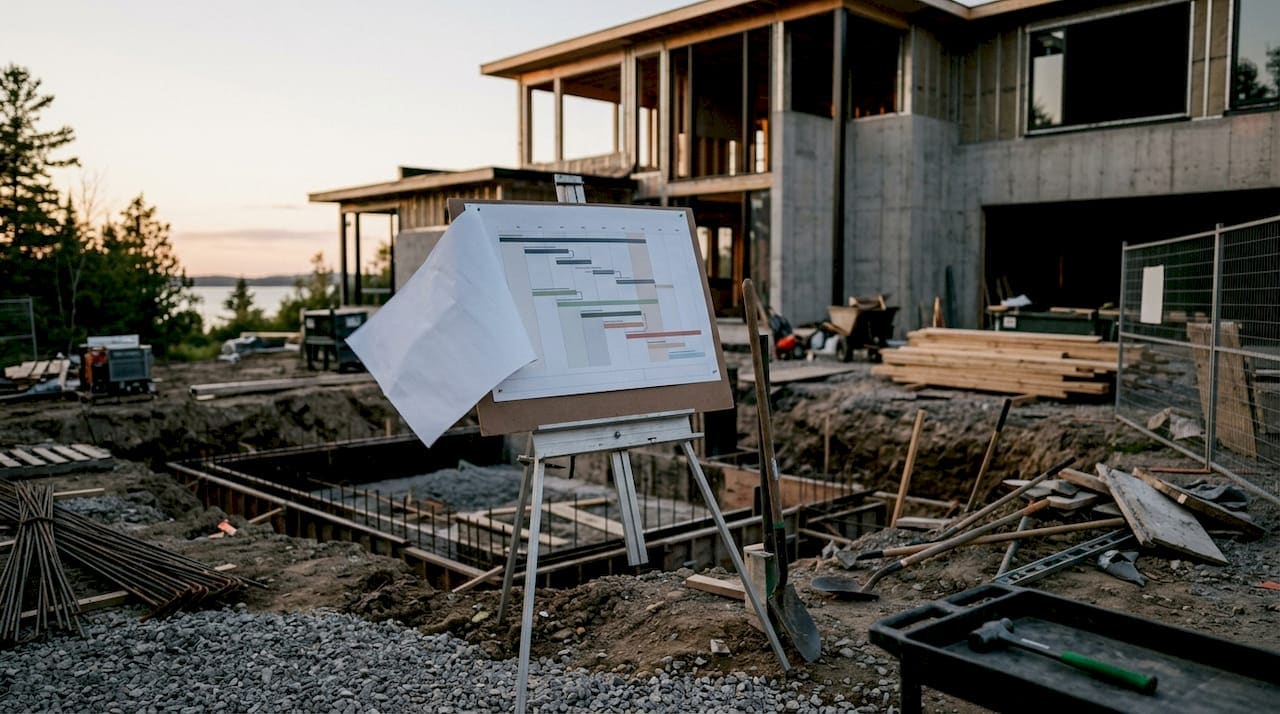
- Stakeholder reviews: Share a summary view of the timeline with clients or sponsors at regular intervals. Use a visual format, such as a Gantt chart, so non-technical stakeholders can read it quickly.
- Scope change protocol: When scope changes, update the timeline immediately. Do not absorb new work into the existing schedule without adjusting dates or resources.
Variance analysis compares planned versus actual progress. If a task was scheduled to finish on a Friday and it finishes the following Wednesday, that is four days of negative variance. Track it, understand the cause, and decide whether to recover the time or adjust the downstream schedule. Ignoring variance is how small delays become project failures.
For construction projects in South Georgian Bay, Mightonconstruction uses this approach on every build, from kitchen renovations in Collingwood to large-scale custom homes in Blue Mountain. Transparent communication around the schedule is one of the most consistent pieces of feedback clients share.
Pro Tip: Colour-code your Gantt chart by status: green for on track, amber for at risk, and red for delayed. A single-page visual update shared before every stakeholder meeting replaces three pages of written explanation.
You can also apply these principles to broader construction planning. The construction timeline essentials guide from Mightonconstruction covers how these steps translate directly to residential builds in Ontario.
For cross-industry perspective on how timeline and milestone tracking applies beyond residential construction, the fencing project management guide from Jumalu Tech offers a useful comparison of how dependency mapping and schedule monitoring work in field-based projects.
Key takeaways
A reliable project timeline requires five core components, a structured breakdown of work, dependency mapping, three-point duration estimates, and a consistent update cadence to remain useful throughout the project lifecycle.
| Point | Details |
|---|---|
| Five core components | Every timeline needs milestones, owners, dependencies, realistic durations, and a baseline. |
| WBS sizing | Break work into packages of 2–10 days for reliable estimates and easier scope management. |
| Three-point estimation | Use the PERT formula (O + 4M + P) ÷ 6 to remove optimism bias from duration estimates. |
| Backward planning | Start from the fixed deadline and work backward to confirm whether the start date is feasible. |
| Living document mindset | Update the schedule weekly, track variance against the baseline, and share it visibly with stakeholders. |
Why most project timelines fail before the work even starts
The timelines I see fail most often are not undone by bad execution. They are undone by bad architecture. The scope was vague, the WBS was shallow, and the dependencies were assumed rather than mapped. By the time the first trade shows up on site, the schedule is already fiction.
The hardest mindset shift is accepting that a timeline is never finished. I have worked alongside project managers who treated the schedule as a deliverable to be submitted and filed. The moment they stopped updating it, they lost the ability to make good decisions. A schedule that does not reflect current reality is not a management tool. It is a liability.
The other pattern I see consistently is that teams underestimate the cost of optimistic estimates. Everyone wants to show a fast schedule at kickoff. But a timeline built on best-case assumptions fails at the first disruption, and in construction, disruptions are not exceptions. They are the norm. Three-point estimation feels slower at the planning stage. It saves weeks at the execution stage.
Stakeholder buy-in matters more than most project managers admit. When the client or sponsor has not been involved in building the timeline, they do not trust it. They push back on dates, request changes without understanding the downstream impact, and disengage from the process. Bring key stakeholders into the dependency review and the milestone sign-off. Their investment in the schedule is what makes it hold.
— Adam
Mightonconstruction’s approach to complex project scheduling
Managing a luxury waterfront cottage or a full home renovation in South Georgian Bay means coordinating dozens of trades, suppliers, permits, and inspections across a schedule that cannot afford to slip.

Mightonconstruction brings over 30 years of local expertise to every project timeline, from the initial scope definition through to final walkthrough. The team manages dependencies, tracks variance against the baseline, and communicates proactively with clients at every stage. For homeowners planning a custom cottage in Wasaga Beach or a bathroom renovation in Collingwood, that level of schedule discipline is what keeps projects on time and on budget. Contact Mightonconstruction to discuss your project and get a clear timeline from day one.
FAQ
What is a project timeline?
A project timeline is a structured schedule that organises tasks, milestones, durations, dependencies, and owners into a single plan used to manage delivery and coordinate resources.
What are the five core elements of an effective project timeline?
An effective timeline includes clear milestones, assigned owners, defined dependencies, realistic duration estimates, and a schedule baseline for tracking variance.
What is three-point estimation in project scheduling?
Three-point estimation calculates expected task duration using the formula (Optimistic + 4 × Most Likely + Pessimistic) ÷ 6, reducing the optimism bias that causes schedules to fail.
How often should a project timeline be updated?
A project timeline should be updated at least weekly, with variance tracked against the baseline and changes communicated to stakeholders at every review cycle.
What is the critical path in a project schedule?
The critical path is the longest sequence of dependent tasks that determines the project end date. Any delay on the critical path directly delays the final delivery.